Security advice GLS brand impersonation
At GLS Spain we have detected an increase in cases in which our name and brand image are used to commit fraud related to the shipment of goods, mostly on platforms for the sale of second-hand products on the Internet. We provide some tips to detect them and avoid being victims when we find ourselves before them:
- At GLS we do not transport cash (currency in legal tender), securities or bank checks.
- We do not intervene in economic money transactions, either between individuals or between companies.
- We are not intermediaries or depositories in the sale of second-hand products.
- We do not request payment details by e-mail or SMS to create a customer account at GLS Spain. In case you are expecting a parcel from a non-EU country or if you are based in a non-EU country you may be contacted to pay duties & taxes by Email, SMS or letter by either GLS or an authorized agent.
- We do not use online platforms dedicated to the sale of products to promote our shipments or services.
- For our communications, we use the email domain “xxxx@gls-spain.es”, “xxxx@comunicaciones.gls-spain.com” or “xxxx@gls-spain.com”.
- GLS Spain doesn´t have a customer service line beginning with 807.
- The official website of GLS Spain is gls-spain.es, so we only send e-mails and SMS with links that lead to it. Report here those emails that do not meet these characteristics.
- We only charge for expenses incurred when managing shipments and official GLS services
- We actively collaborate with the State Security Forces to prosecute any fraudulent activity in the use of our corporate image. However, at GLS Spain we have no control over the creation of these fraudulent environments, so we are not responsible for expenses, surcharges or irregular payments made to third parties who impersonate us.
Impersonation of the GLS brand
With the significant growth of e-commerce in recent years, online scam attempts have become increasingly common and sophisticated. Criminals impersonate GLS Spain by using social media, sending fake emails or SMS messages, among other methods. These typically include requests for payments or personal data.
In addition to this fraudulent use of our name and brand image, there are occasional cases in which scammers spoof phone numbers to send communications (spoofing). These cases, often identified as smishing (phishing via SMS), make scams harder to detect. We strongly advise exercising extreme caution and avoiding clicking on any links.
Recipients of these messages should inform GLS Spain immediately and under no circumstances comply with requests for payment or personal data. It is not recommended to attempt to expose the scammers, as in the case of random scam attempts, this would confirm that the account is active and may lead to further fraud attempts.
GLS Spain will never request payment from recipients via email through online payment platforms (except for cash-on-delivery shipments, which can be paid in cash at the time of delivery), credit cards, or bank transfers.
Avoid sharing your credit card details, making bank transfers, or downloading attachments. If you have provided bank details or made any payment, contact your bank immediately.
GLS Spain is not responsible for damages caused by scams involving identity impersonation. Therefore, GLS Spain accepts no liability for any costs, charges, or payments unlawfully incurred as a result of such fraud.
Contact us to report any suspicious activity to our Information Security team.
Types of scams and communication channels
There are various types of scams that use different communication channels, such as:
- Fraudulent emails
- SMS or WhatsApp messages
- Fake websites
- Social media
GLS Spain maintains a proactive approach in combating these scams and appreciates any reports of suspicious activity involving the misuse of our brand. Please notify us immediately if you suspect that an email or SMS may be fraudulent, or if a website or social media account is impersonating us, so that we can take appropriate action to stop the scam.
We will carefully review each report received; however, we generally do not respond to individual inquiries. If you have questions about the status of a shipment, please contact our Customer Service team directly.
Fraudulent e-mails
GLS Spain only sends emails to its recipients and customers regarding delivery instructions and information about the status of shipments. GLS Spain will never request payments through online payment platforms (except for cash-on-delivery shipments, which can be paid in cash at the time of delivery), credit cards, or bank transfers.
Warning signs to look out for:
• The sender uses pressure, threats, or negative consequences to rush the recipient. Their intention is to prevent you from assessing the legitimacy of the request.
• Spelling and/or grammatical errors. Many of these scams are not created by native speakers and rely on online translators, often resulting in noticeable mistakes that reveal their fraudulent origin.
• If the message contains links, hovering over them will display the actual destination URL in the bottom-left corner of your screen. Be suspicious if the address does not match what you would expect from an official website.
• The sender’s email address comes from domains such as @gmail, @gmx, @yahoo, or others not created by GLS Spain. Remember that our official communications come from domains such as “xxxx@gls-spain.es”, “xxxx@comunicaciones.gls-spain.com”, or “xxxx@gls-spain.com”.
To effectively combat fraudulent emails, please send us the email as an attachment. You may also send screenshots, URLs, suspicious content, or any other evidence that could help identify the scam. Simply forwarding an email is often not enough, as important data may be lost. Therefore, sending the original email as an attachment is the best way to provide evidence.
Fraudulent telephones
In some fraudulent ads that you may find on Google, a phone number is provided which later prompts you to call a number starting with 807. Do not do this—no useful information will be provided, and the aim is simply to artificially prolong the call. Numbers starting with 807 do not belong to or have any relation to GLS Spain. If you contact us, you will never be redirected to such a number. To ensure you are speaking with a GLS Spain partner agency or branch, please contact us via +34 910 80 62 29.
GLS Spain has reported this practice in order to have it removed as soon as possible. If you have been a victim of this scam, please send us the details through the fraud report form so we can gather more information to help eliminate this fraudulent activity.
If you have shared your phone number through any channel, scammers may contact you via WhatsApp or traditional phone calls, often from foreign numbers. If the phone prefix is not Spain’s +34, be cautious.
SMS or WhatsApp
If you are receiving fraudulent messages via SMS or WhatsApp, please send us screenshots of the conversations, as well as the name of the contact and the phone number of the person sending them. If the phone number contacting you is from abroad, be cautious.
There have been isolated cases of smishing (phishing via SMS) in which, in addition to impersonating companies’ identities, the phone number is spoofed, making the fraud harder to detect.
If you have any doubts about the origin of a message, do not click on any links and do not share any personal data.
Fake websites
GLS Spain has detected several fake websites that were using our logos, names, and content. These were used by criminals to scam both customers and non-customers of GLS Spain. These websites are designed to deceive recipients and obtain sensitive data such as login credentials or financial information.
The official GLS Spain website in Spanish is www.gls-group.com/ES . Any other domain should be considered suspicious and, therefore, should not be accessed. You can access the rest of the GLS Group domains at www.gls-group.eu .
If you are unsure whether a website is legitimate, you should first verify the following points:
• Does the URL have any relation to GLS Spain? If the name is not related to our brand, it is likely to be a fake website.
• Is the connection to the website secure? On the left side of the URL there should be a padlock, indicating that the website’s certificate is valid and browsing is secure. However, this should not be taken as a definitive sign of legitimacy, as certificates can sometimes also be obtained for fraudulent sites.
• Check the policies at the bottom of the homepage (privacy policy, legal notice, terms and conditions, etc.). In many cases, scammers do not bother to complete these sections.
• Does the website look professional? These fake sites often consist only of a homepage, and other sections may not work. Also check for spelling errors.
These four indicators must be assessed together, as no single one alone guarantees the legitimacy of a website.
If a website looks suspicious to you, please report it to us immediately by sending the link. We will investigate and take the necessary measures if the domain is found to be fraudulent.
Social networks
GLS Spain manages official accounts on social media, including Facebook , Instagram , TikTok , and X, where we operate two accounts: a general one and another dedicated to customer service . On our accounts, you will always find a link to our website www.gls-group.com/ES/ , as well as a long history of posts. In addition, we will only contact you to respond to questions you have previously submitted.
Below are some indicators to help identify fraudulent accounts:
• The account has been created recently, usually within the last few weeks or months.
• The account does not provide official contact channels or company information.
• The account uses an individual name for customer service, for example, “Elisa Help Desk”. At GLS Spain, we only assist through our official accounts.
• The account does not include a link to our official website.
• The account contacts you proactively without you having made any prior inquiry.
• The account offers special giveaways or refers to websites other than
www.gls-group.com/ES/.
If you have any doubts about the legitimacy of an account, please report it immediately. If impersonation is confirmed, the matter will be reported to the social media platform for removal. You may also report it directly to the platform provider.
Examples of detected scams
Below are some examples of real scams reported to us by recipients.
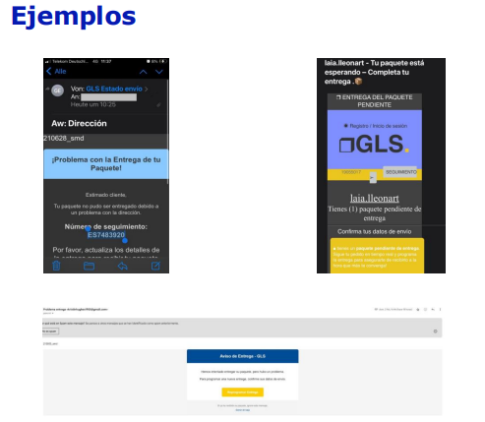
Frequently, users receive emails urging them to resolve a problem with a package delivery or to confirm a shipment that is pending delivery. If you click on the links in these emails, you may be asked to provide personal and banking details or, in some cases, you may be directly required to make a payment in order to receive the shipment.
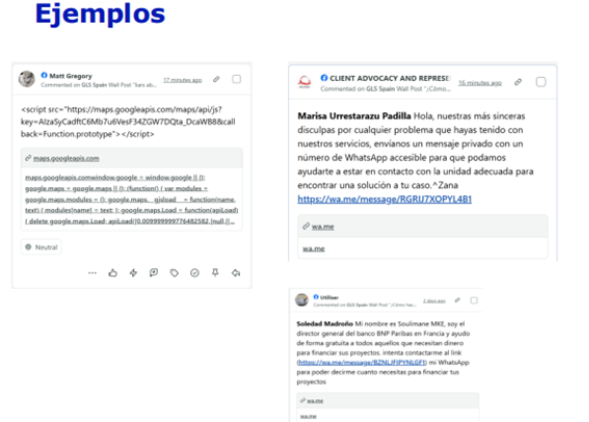
On social media, some users attempt to impersonate GLS Spain, posting public or private messages in which they apologize for a supposed issue and request personal data via private message. In some cases, they subsequently contact you via WhatsApp to request banking details, ask you to click on links that lead to fraudulent websites, or directly demand a payment to confirm the shipment you are waiting for.
View examples
Other fraud attempts originate from fake profiles on second-hand buying and selling platforms between private users (such as Beseif, Wallapop, Milanuncios, etc.). The most common method is to contact a user selling an item, express interest in the product, and offer payment through intermediaries or cash on delivery. Once they obtain the phone number and email address, they contact the victim pretending to be GLS Spain and request an amount for “package handling costs” to prevent damage or breakage, as shown in the following image.
Later in the same email, they provide a bank account number to make the payment.
The blue hyperlink stating “click here to open your GLS premium account” redirects to a page where you are asked to fill out a form with your credit card information.
In some cases, they do not even create a form and instead request the information directly in the email itself, as shown in the following image.
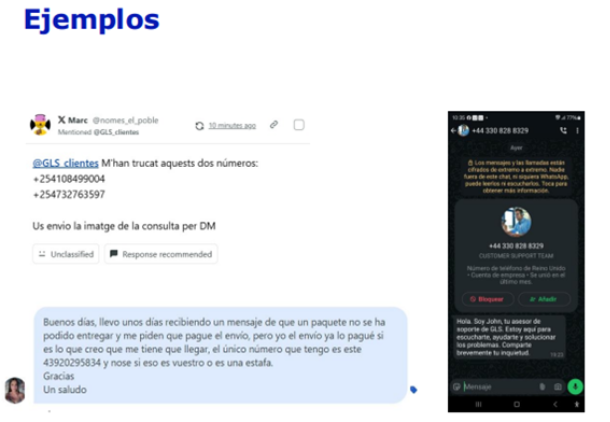
Email is often used in combination with WhatsApp messages sent from foreign numbers, as shown in the following example .
If you have been a victim of fraud, we always recommend reporting the incident to the relevant law enforcement authorities.